Wednesday, October 29, 2008

Persepolis!

I think that pg 102 of Persepolis has a good dialogue with the final lines of "I explain a few things" by Pablo Neruda.

Neruda writes:

...bandits with black friars spattering blessings
came through the sky to kill children
and the blood of children ran through the streets
without fuss, like children's blood.

It is a singularly powerful image where the cruelty of adults sacrifices the lives of children. It is echoed on the first panel of the page in Persepolis where the children are dying in explosions, the keys to heaven dangling on their necks.

Neither are blessed, heaven's promise not quite assuaging the grim reality of their sudden deaths.

So how does the conflict forge identity? The general worldview that the writers have in common (because of war) is that it serves no purpose save to beguile and bewilder the youth, robbing them of a future and change what is beautiful about a nation into something sordid and vile through the violence of the war. That is what war is. It serves no great purpose. People fight and are forgotten, save for the few that history turns into heroes. Time, after all, creates heroes and dissolves celebrities. The glory is all that is remembered if time passes enough. For these writers, the war and effects of war is still too close and will forever remain close all their lives. That is what war does. Even the unscathed are scarred (I had a friend who would always flinch whenever he heard sirens. It always reminded him of bombing warnings, he told me).

Tuesday, October 28, 2008

Quickie on...War Is Kind

I liked this poem. It was pretty straightforward in its message (because hey, war is not kind), and even I understood it. Plus, Crane gets extra points for actually having lived through the Civil War and thus saw the events first hand (giving him street cred, or something. I can't really remember, but he might have died during the civil war as well...but I'm too lazy to google it at the moment so we'll just say he died. It makes for a more compelling story). The use of sarcasm juxtaposed with the harsh imagery really drives home the message, but I feel somewhat the Crane approaches the subject with the subtlety of a sledgehammer. But that's just me.

It doesn't detract from the fact that the poem is a very effective piece of work for what it intends to do (and it is rather eloquent with its stark images of violence). I also like the fact that the poem manages to evoke sounds of the battlefield with the wording.

I chose not to write about persepolis because I already did the reader's response about it.

Wednesday, October 15, 2008

Blankets

I liked the surreal aspects of pages 42 and 43 and it begins to show Thompson's need for his escapist tendencies which later boil over to religious fervor. To say that his belief in religion was a mistake would be unfair. Belief in itself is never a mistake, but something to be envied and admired. But I digress...to me, everything that fueled Thompson's early life from his love of art to his need to dream was a form of escapism (he says it himself at one point). This, coupled with the need for acceptance in a world he felt did not want him, led him to religion. Pages 49 and 51 are indicative of this.

More importantly, it is interesting to note that there is an artistic correlation between page 42 and page 51 (where he first states he wants heaven). The theme of blankets can be shown here in that in page 42 he is shown being enveloped by an exotic cloud (which then transforms into his dream playground) and page 51 is a similar splash page (though cleaned up of the exotic elements), suggesting a need to be...safe and protected (especially from the darkness of the background, in my opinion).

This idea of using religion as a safe haven draws parallels with Winterson's book (as Jeanette also found comfort in religion). Both main characters have a special relationship with God, in that they see him as unjudgmental and a steadfast friend in the face of a confusing world. How they are forced from that place of comfort, however, is quite different and it is here that I become a little disgruntled. Jeanette is literally forced from her haven as a result of her choice, whereas Thompson releases himself from his haven into the outside world. For him, religion is his last blanket, but the reason it bothers me is...it felt so sudden. I won't spoil anything (and I hope I was sufficiently obscure in my allusions to affect this), but it just...really....BOTHERS ME! Argh! I can't put my finger on it exactly, but there it is.

And for those who read this and feel that I have unnecessarily spoiled your reading...I apologize. But it still bothers me.

Addendum:

I also liked page 60, where Thompson burns his drawings and releases everything in him. The childhood memories welling out from his mouth are a great way to show his purging or his youth and there's an almost pagan aspect to it (he's in front of a fire, his eyes waxy and empty in a trance state). The dreams loom large on the page, taking up the entirety of the sky, perhaps suggesting their importance or how much a part of his life they really were. It's possibly one of the most powerful images in the book.

Monday, October 13, 2008

Belief


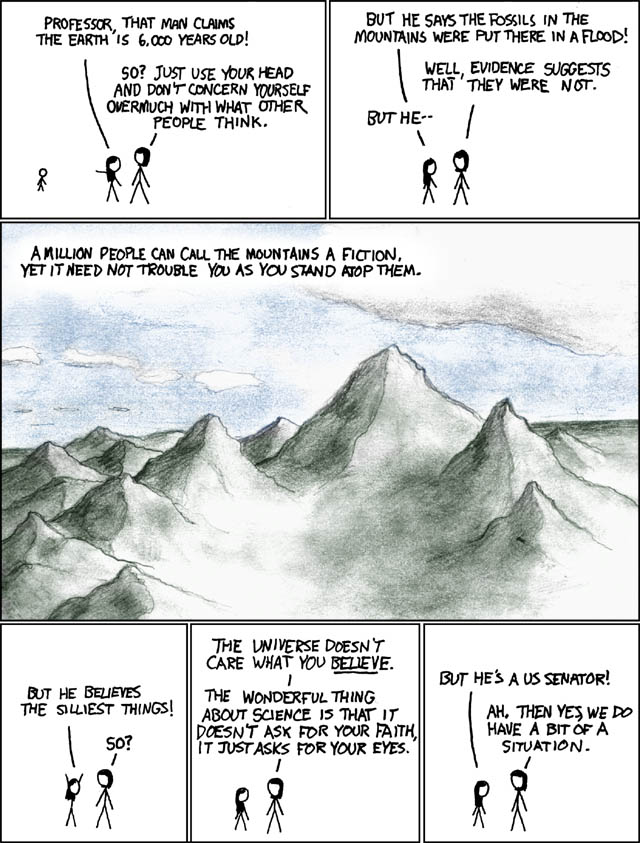
Well, I agree with this comic.

Cynicism aside, I believe in God but I also believe that he gave us brains for a reason. Faith doesn't (and shouldn't) preclude logic. There is an old Arabian adage that comes to mind: "Trust in God, but tether your sheep". A dogmatic view of the world, especially an unbending one, serves no purpose in this day an age (though for some reason many people still can't accept that). I believe that religion was put on this Earth to unify people and edify them, not cause disharmony and divide them. It is our differences that allow us to move forward. The only tragedy is that people often use it as a reason to hold each other back.

Clearly, my belief system is shaped by my parents and the schools that I have gone to. I am fortunate in that my religion has not gotten in the way of my learning. I don't have to struggle with the idea that the world is 6000 years old and that humans rode dinosaurs. My religion doesn't see knowledge as a sin, after all.

The time that I most vividly recall where my belief system was challenged was when I visited New York and was accosted by Scientologists. That was one of the few times I have ever come across a group of people who I wanted to smack based on their beliefs. It was not so much that I dismiss their belief system (though I do), but the fact that I was shocked that they tried to force that system down my throat. I'm all for a civil debate about religion, but they were just ridiculous!

In Oranges are not the Only Fruit it is apparent that the church Jeanette attends (and the close society that attends it) adheres to a very strict construction of the Bible. The belief that is immediately challenged (that comes to the top of my mind at any rate) concerns sexuality. Jeanette was ostracized for having "unnatural passions" (pg 89, 104-110...ish)and the society, though having outwardly forgiven Jeanette's mother, has not forgotten that "she knows the ways of the world".

She finally breaks away from the Church, unrepentant of her love choices in the face of the unbending rules of the Church and divorces herself emotionally from that society (can't remember where it is...I'll find it later).

Wednesday, September 24, 2008

Know thyself

Well, the long and short of it is that Emerson suggests that being other than yourself and not believing in yourself is the most heinous crime someone can inflict on themselves.

Jin could not accept himself as being different from his peers and longed to be more like them. Peer pressure is a horrible thing.

Of course, I have to wonder, how does one define which part of himself is the truest part of his being? I suppose the closest to answering that question is simply that...you'd just know (that's the simple answer, btw).

I have to quote a cartoon now (in this case, The Iron Giant). Enjoy the clip!:


So what's the point I'm getting to? All the messages boil down to one simple meaning (yes, even the one in the cartoon): A swan cannot be anything other than what it is. It is a swan, so it would be silly to pretend to be a lion.

Like Emerson said, "Trust to thyself: every heart vibrates to that iron string". Anything else, any other action, is just self destruction.

PS: In the cartoon, the robot couldn't help but be a hero. That's what I was trying to point out when I put that clip up. And yes, I know it's a long clip. I couldn't find a shorter version of that scene. Also, Brad Bird rocks.

Monday, September 22, 2008

American Born Chinese Impressions

I was intrigued by the reading. I like how the different, seemingly disjointed stories have the same theme running through it: finding a place to belong. Trying to be accepted into the larger part of society by discarding and ignoring the truth about yourself.

The page that most interested me was page 36, in that it parallels Jin's arrival to the class as well (almost panel for panel). I like it because it portrays the subtle misconceptions and prejudices of the class (and probably the small town by extension). But the reason I like page 36 was the final line in the last panel of the page: "something made me want to beat him up".

What does it all mean? One could argue that the "cultural melting pot" is at work here, that Jin has tried his best to conform to the American standard, thus distancing himself from the traits that made him unacceptable to his peers (and that Wei-Chen's arrival was a reminder of that). As inferred by the poem "It's gotta be the cheese", this pasteurization of the class's society sacrifices the flavour of a unique culture entering in its midst by trivializing it with prejudice (and making everything homogenous like processed cheese).

On a multimodal note, the panels and parallels between pages 30 and 36 is very much akin to a repeated stanza in poetry with the subtle changes. Jin replaces the intolerant boy on page 30 in not only spirit but expression as well. It is an interesting way to show that he is now one of the class and that though he knows better he partakes in the distancing of Wei-Chen rather than lending a helping hand to adjust.

Wednesday, September 17, 2008

Thoughts on bell hooks

Why does hooks use popular culture to carry her message? Because it is an effective medium due to its familiarity. It allows her to make people have a second look at the things they think they recognize and are familiar with. It is a rather postmodernist approach, taking two dissimilar qualities and ideas and juxtaposing them to illustrate a point. Her point about the concerted effort to regress the feminist movement through careful use of movie images and like media was intriguing (I'll never see Leaving Last Vegas in the same light again).