Wednesday, November 19, 2008

Gaiman: Madman or really smart guy?

I liked it. Classics are classics because they inspire thought and invite interpretation. And while there have been egregious "remakes" and interpretations on past stories (I'm looking at you, Hollywood! Stop remaking movies already!), Gaiman's offering is smart, witty, and an interesting view on Shakespeare's classic.

And yes, I would say that it helps cut through the clutter that the archaic writing sets before the casual reader (and helps with understanding the story better).

The liberties, if anything, lie in the way the play within the story is repeatedly truncated (for the sake of space and time), which is unavoidable. Gaiman does, however, add layers to the characters of the story not readily apparent in the original tale. Puck seems more malevolent in this version (though it might just be the look of him) but he is ever the mischief maker. Titania and Oberon seem much more noble and less petty than the original counterparts and it's all packaged oh so ever neatly.

So yeah, maybe people don't like it because it is not traditional and impugns on some imagined sacred taboo, but that's the whole problem: it's imagined. Literature should not be taken as some untouchable sacred cow but as a work of creativity. And works of creativity should inspire more creativity.

Monday, November 17, 2008

Breaking the fourth wall: Puck's speech

Everybody loves Puck's speech because it's just so gosh darn cool. It appears in great movies like "Dead Poet's Society" because it's so gosh darn cool (which is the primary reason it sticks in my mind like a wet booger).

Anyway, the reason why it is so gosh darned cool is because Puck does something that is quite rare (at least during Shakespeare's period): he breaks the fourth wall. That is instead of being contained within the story of the play he includes the audience by directly speaking to them recognizing the otherwise invisible watchers.

He literally says "well, if you didn't like what you saw tonight, pretend it was a dream!" (Act 5, scene 2...though Puck says it much more eloquently).

It reveals Puck to be a playful lout, the speech that is, but who is nevertheless earnest in his playful ways. He asks to be forgiven for any transgressions done, and that he'd make amends if he has offended, mending any broken friendships.

It is a very tongue in cheek moment.

The language is effective here because it is direct (though some may argue that point). Puck states his intent in the first two lines. The rest of the speech is just following up those thoughts.

The ultimate love triangle thing!

It's been a while since I read the play, so excuse me if I come off a bit muddleheaded.

Oberon loves Titania but, let's face it, he's a bit of a dick. He makes her fall in love with someone else (some vile thing, which turns out to be Bottom), and in some places that would be grounds for divorce.

Or at least a spot on the Maury show (headline: you made me fall in love with an ass so I want a divorce!).

But, as in all of Shakespeare's comedies, everything is resolved in the end and everybody makes up and/or gets married.

Hooray!

Monday, November 3, 2008

Thesis idea maybe?

My basic idea is about how war and conflict causes society to constrict on itself and become insular, forcefully demonizing anything that is foreign to that particular society's core value system. It happened in world war 2 when the american government forced citizens of japanese descent into labour camps, and the post 9-11 environment where arabs were ostracized by the general public, and (most importantly) the systematic banning of all things western by the Iranian government in Sartrapi's Persepolis.

Ugh...sounds heavy. Help!

Oh, and I totally want to do a multi-genre paper. I doubt anybody wants to do a traditional piece.


Addendum: going through everybody's posts...it seems like i was wrong...

Wednesday, October 29, 2008

Persepolis!

I think that pg 102 of Persepolis has a good dialogue with the final lines of "I explain a few things" by Pablo Neruda.

Neruda writes:

...bandits with black friars spattering blessings
came through the sky to kill children
and the blood of children ran through the streets
without fuss, like children's blood.

It is a singularly powerful image where the cruelty of adults sacrifices the lives of children. It is echoed on the first panel of the page in Persepolis where the children are dying in explosions, the keys to heaven dangling on their necks.

Neither are blessed, heaven's promise not quite assuaging the grim reality of their sudden deaths.

So how does the conflict forge identity? The general worldview that the writers have in common (because of war) is that it serves no purpose save to beguile and bewilder the youth, robbing them of a future and change what is beautiful about a nation into something sordid and vile through the violence of the war. That is what war is. It serves no great purpose. People fight and are forgotten, save for the few that history turns into heroes. Time, after all, creates heroes and dissolves celebrities. The glory is all that is remembered if time passes enough. For these writers, the war and effects of war is still too close and will forever remain close all their lives. That is what war does. Even the unscathed are scarred (I had a friend who would always flinch whenever he heard sirens. It always reminded him of bombing warnings, he told me).

Tuesday, October 28, 2008

Quickie on...War Is Kind

I liked this poem. It was pretty straightforward in its message (because hey, war is not kind), and even I understood it. Plus, Crane gets extra points for actually having lived through the Civil War and thus saw the events first hand (giving him street cred, or something. I can't really remember, but he might have died during the civil war as well...but I'm too lazy to google it at the moment so we'll just say he died. It makes for a more compelling story). The use of sarcasm juxtaposed with the harsh imagery really drives home the message, but I feel somewhat the Crane approaches the subject with the subtlety of a sledgehammer. But that's just me.

It doesn't detract from the fact that the poem is a very effective piece of work for what it intends to do (and it is rather eloquent with its stark images of violence). I also like the fact that the poem manages to evoke sounds of the battlefield with the wording.

I chose not to write about persepolis because I already did the reader's response about it.

Wednesday, October 15, 2008

Blankets

I liked the surreal aspects of pages 42 and 43 and it begins to show Thompson's need for his escapist tendencies which later boil over to religious fervor. To say that his belief in religion was a mistake would be unfair. Belief in itself is never a mistake, but something to be envied and admired. But I digress...to me, everything that fueled Thompson's early life from his love of art to his need to dream was a form of escapism (he says it himself at one point). This, coupled with the need for acceptance in a world he felt did not want him, led him to religion. Pages 49 and 51 are indicative of this.

More importantly, it is interesting to note that there is an artistic correlation between page 42 and page 51 (where he first states he wants heaven). The theme of blankets can be shown here in that in page 42 he is shown being enveloped by an exotic cloud (which then transforms into his dream playground) and page 51 is a similar splash page (though cleaned up of the exotic elements), suggesting a need to be...safe and protected (especially from the darkness of the background, in my opinion).

This idea of using religion as a safe haven draws parallels with Winterson's book (as Jeanette also found comfort in religion). Both main characters have a special relationship with God, in that they see him as unjudgmental and a steadfast friend in the face of a confusing world. How they are forced from that place of comfort, however, is quite different and it is here that I become a little disgruntled. Jeanette is literally forced from her haven as a result of her choice, whereas Thompson releases himself from his haven into the outside world. For him, religion is his last blanket, but the reason it bothers me is...it felt so sudden. I won't spoil anything (and I hope I was sufficiently obscure in my allusions to affect this), but it just...really....BOTHERS ME! Argh! I can't put my finger on it exactly, but there it is.

And for those who read this and feel that I have unnecessarily spoiled your reading...I apologize. But it still bothers me.

Addendum:

I also liked page 60, where Thompson burns his drawings and releases everything in him. The childhood memories welling out from his mouth are a great way to show his purging or his youth and there's an almost pagan aspect to it (he's in front of a fire, his eyes waxy and empty in a trance state). The dreams loom large on the page, taking up the entirety of the sky, perhaps suggesting their importance or how much a part of his life they really were. It's possibly one of the most powerful images in the book.

Monday, October 13, 2008

Belief


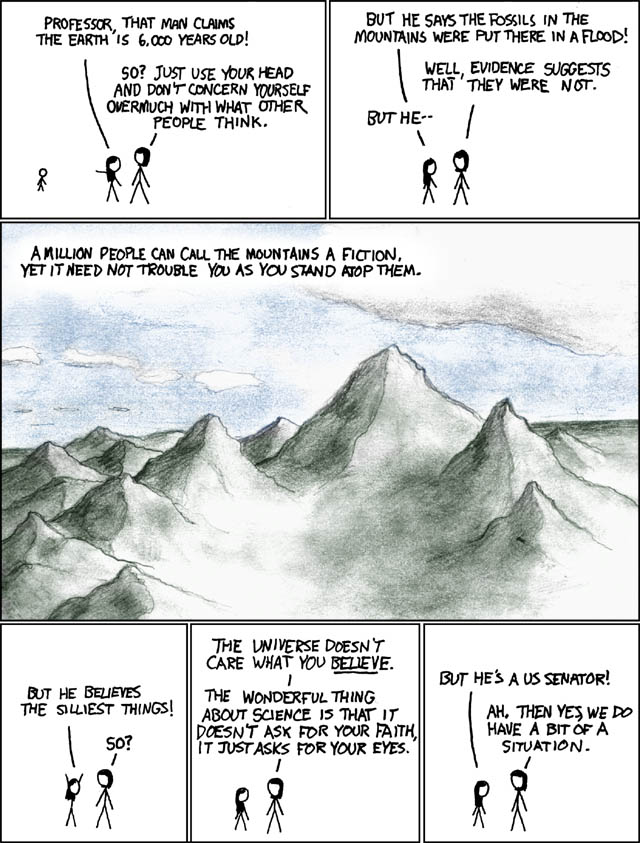
Well, I agree with this comic.

Cynicism aside, I believe in God but I also believe that he gave us brains for a reason. Faith doesn't (and shouldn't) preclude logic. There is an old Arabian adage that comes to mind: "Trust in God, but tether your sheep". A dogmatic view of the world, especially an unbending one, serves no purpose in this day an age (though for some reason many people still can't accept that). I believe that religion was put on this Earth to unify people and edify them, not cause disharmony and divide them. It is our differences that allow us to move forward. The only tragedy is that people often use it as a reason to hold each other back.

Clearly, my belief system is shaped by my parents and the schools that I have gone to. I am fortunate in that my religion has not gotten in the way of my learning. I don't have to struggle with the idea that the world is 6000 years old and that humans rode dinosaurs. My religion doesn't see knowledge as a sin, after all.

The time that I most vividly recall where my belief system was challenged was when I visited New York and was accosted by Scientologists. That was one of the few times I have ever come across a group of people who I wanted to smack based on their beliefs. It was not so much that I dismiss their belief system (though I do), but the fact that I was shocked that they tried to force that system down my throat. I'm all for a civil debate about religion, but they were just ridiculous!

In Oranges are not the Only Fruit it is apparent that the church Jeanette attends (and the close society that attends it) adheres to a very strict construction of the Bible. The belief that is immediately challenged (that comes to the top of my mind at any rate) concerns sexuality. Jeanette was ostracized for having "unnatural passions" (pg 89, 104-110...ish)and the society, though having outwardly forgiven Jeanette's mother, has not forgotten that "she knows the ways of the world".

She finally breaks away from the Church, unrepentant of her love choices in the face of the unbending rules of the Church and divorces herself emotionally from that society (can't remember where it is...I'll find it later).

Wednesday, September 24, 2008

Know thyself

Well, the long and short of it is that Emerson suggests that being other than yourself and not believing in yourself is the most heinous crime someone can inflict on themselves.

Jin could not accept himself as being different from his peers and longed to be more like them. Peer pressure is a horrible thing.

Of course, I have to wonder, how does one define which part of himself is the truest part of his being? I suppose the closest to answering that question is simply that...you'd just know (that's the simple answer, btw).

I have to quote a cartoon now (in this case, The Iron Giant). Enjoy the clip!:


So what's the point I'm getting to? All the messages boil down to one simple meaning (yes, even the one in the cartoon): A swan cannot be anything other than what it is. It is a swan, so it would be silly to pretend to be a lion.

Like Emerson said, "Trust to thyself: every heart vibrates to that iron string". Anything else, any other action, is just self destruction.

PS: In the cartoon, the robot couldn't help but be a hero. That's what I was trying to point out when I put that clip up. And yes, I know it's a long clip. I couldn't find a shorter version of that scene. Also, Brad Bird rocks.

Monday, September 22, 2008

American Born Chinese Impressions

I was intrigued by the reading. I like how the different, seemingly disjointed stories have the same theme running through it: finding a place to belong. Trying to be accepted into the larger part of society by discarding and ignoring the truth about yourself.

The page that most interested me was page 36, in that it parallels Jin's arrival to the class as well (almost panel for panel). I like it because it portrays the subtle misconceptions and prejudices of the class (and probably the small town by extension). But the reason I like page 36 was the final line in the last panel of the page: "something made me want to beat him up".

What does it all mean? One could argue that the "cultural melting pot" is at work here, that Jin has tried his best to conform to the American standard, thus distancing himself from the traits that made him unacceptable to his peers (and that Wei-Chen's arrival was a reminder of that). As inferred by the poem "It's gotta be the cheese", this pasteurization of the class's society sacrifices the flavour of a unique culture entering in its midst by trivializing it with prejudice (and making everything homogenous like processed cheese).

On a multimodal note, the panels and parallels between pages 30 and 36 is very much akin to a repeated stanza in poetry with the subtle changes. Jin replaces the intolerant boy on page 30 in not only spirit but expression as well. It is an interesting way to show that he is now one of the class and that though he knows better he partakes in the distancing of Wei-Chen rather than lending a helping hand to adjust.

Wednesday, September 17, 2008

Thoughts on bell hooks

Why does hooks use popular culture to carry her message? Because it is an effective medium due to its familiarity. It allows her to make people have a second look at the things they think they recognize and are familiar with. It is a rather postmodernist approach, taking two dissimilar qualities and ideas and juxtaposing them to illustrate a point. Her point about the concerted effort to regress the feminist movement through careful use of movie images and like media was intriguing (I'll never see Leaving Last Vegas in the same light again).

Monday, September 15, 2008

La Guernica

If we analyze this piece using Bang's methods of interpretations we'd find:

i That the center of the page, the point of most attraction, is dominated by the image of the panicked horse.

ii The horse itself consists of many jagged portions that lend to the feeling of fear and foreboding that the picture invokes. Indeed, there is an abundance of jagged edges in the picture that emphasize and add to that feeling of panic, hysteria and fear.

iii Even the organic shapes that usually invoke a sense of peace and safety (the humans and animals) are far rougher than their real life counterparts, and the lack of symmetry proves to be somewhat unsettling.

iv The background is primarily black, again adding a sense of fear to the picture.

v The sense of freedom that the upper half could potentially invoke (according to Bang) is significantly diminished in that there is almost a lack of an upper half. Most of the picture is dominated by the large figures screaming in fear and this is what our eyes focus on.

vi I'm sure I'm not the only one who noticed this, but did anyone see how the lamp at the top looks like the eye of Sauron from "Lord of the Rings"?


Okay. i think that should be sufficient analysis for this entry. I would like to end this post with a little anecdote:

When Picasso was painting the picture, a German soldier asked him "did you do this?".

Picasso calmly replied, "No, you did."

Okay, that was a badly told anecdote, but I thought that exchange was pretty cool. Hey, I can't help it if I'm bad at telling stories! It was more dramatic when I read it in Reader's Digest many years ago, honest!

Friday, September 12, 2008

Addendum to the real books post

Addendum (this bit was posted after I thought about the question a bit more): I think i went too far left field in my interpretation of the question. I think I still have a valid point though. Anyway, graphic novels and comics are as much "real" books as anything else. All things being equal, they still present ideas, observations and commentary on the world around us. To dismiss a whole medium as being "unreal" or "less serious" because of biases is idiotic and, sadly, rather expected. I chalk it up to Disney and the Disney-fication of the illustrated art.

Cartoons and comics = kiddy fodder.

The japanese don't seem to have this sort of hang up. Watch "Grave of the Fireflies" and tell me that that cartoon didn't have something relevant to say about World War II (and tell me that you didn't cry. I'd call you a liar or a robot. A robot, sir! Unfeeling and cold!).

Okay, enough ranting for tonight. I tend to get carried away when we talk about stuff I enjoy.

'Til next time!

Thursday, September 11, 2008

Real Books...like a processed Pinnochio.

Well, as we know, books are those things made of paper with words and/or/maybe pictures in them. I looked it up in the dictionary, so I'm pretty sure I'm right.

But if we're going real left field with our definitions as to what constitutes reality and real books, then books only exist in our heads. A book is merely a collection of ideas and information (in the shape of pictures and letters) that takes the brain's interaction to truly exist. Much like films are a collection of still pictures that move about really quickly, it takes the brain to make them "move" and have meaning.

So yes. Real books are just ideas and information. So a book can exist on the internet, on a wall or even on paper. I once read a story about a book written in braille and its pages were tattooed blind people. Take a moment for that thought to sink in. Disturbing, isn't it?

Anyway, being a long time fan of the comic medium (and having to defend my hobby countless times), it's safe to say that I have few, if any prejudices concerning the medium. I starting reading them for the art, got bored of the stuff they were churning out and stumbled on books with solid STORIES instead. And it's great because the stories are generally faster to get through than having to wade through than normal books, but has enough fodder for the imagination to latch onto (where in watching movies I become a consumer and only a consumer. Comics allow a little bit more of self interpretation, giving a nice middle ground).

Nowadays, I'm happy to report that comics have reached a point where both art and writing have become important in the storytelling process (the dark knight returns hurt my eyes. It just wasn't pretty enough).

Okay, this post is getting waaay too long. That's all I think is fit to comment about for now.

Wednesday, September 10, 2008

How to read those pesky .cbr comics!

Yeah, I wanted to explain this in class if we had time, but I didn't make it.

Sorry, people.

Anyway, a .cbr file is just a fancy zipped file made specifically for comic book reading. IF you have an image viewer you like using that can just read images sequentially, you can unzip the files by converting (renaming) the .cbr file into a .rar file and unzip it. To do this, you have to go to any windows folder > tools > folder options > view > and uncheck "hide extensions for known file types". Then you can see the ends of files like "mysecrethomework.doc" or "blackmailingthedeanwithpicsofinfidelity.jpg" and stuff. This will enable you to rename the file extensions to anything you want (so you can do the cbr to rar conversion trick).

If this seems like too much a hassle to you and you don't mind downloading and installing a program to just read everything, then this is the link for you! The program is called CDisplay, and it's freeware so you don't have to pay anything to use it. I assure you, the site is free from viruses and the like (though you really should have an antivirus enabled at all times anyway. The internet is a scary place, y'all!). Anyway, the program allows you to just open .cbr files and run it normally and read normally. The thing I really like about the program is that if you get tired and exit the program, you can return to the page you were last reading by just hitting the letter "r". Cool beans!

Anyway, I hope that helps anyone who is a little bit lost.

Tuesday, September 9, 2008

Multipass! (movie joke. You had to have watched it to understand)

Multimodality, multiliteracy, multisemiotics, multitasking, and multigrain. Our society is growing so that single anything is just not good enough. I'll come back to that thought in a moment.

I think pretty much everybody has commented on what multimodality is (the way a person absorbs information using all their senses), so it seems pointless to comment on the definition once again.

I'd rather comment on why it is only natural to embrace all the multi-ness in this day and age. In a word: the internet. That's why it's natural. As I said in my first line, single anythings are not really en vogue these days especially in cyber space. Learning about anything in cyberspace takes multimodality to its natural extreme. Take the death of Anna Nichole Smith: many people learned of it through the internet, updated by the minute with links leading to more links. There was no facet of her life that wasn't catalogued in some shape or form: her drunken videos, her autopsy video (yes, that was out there too), her biography, and all the sordid details of her final years. Any user can be easily saturated with information, and this is true of any subject (provided you search hard enough).

I think that the more we use new telecommunication technologies the more pertinent multisemiotics and the rest of the multis begin to become to us. It's a brave new world, and we're inevitably going to see a new way of learning about the world around us.

This, of course, will somehow end up with us being enslaved by robot masters. James Cameron knows what he's talking about, people!

Monday, September 8, 2008

Persepolis! It's not piracy if you're doing it for education!

Howdy all!

I think this is it. This is the final comic that we'll be needing for the class.

*sigh*...i guess I have to go back to being un-useful again. It was nice while it lasted.

Persepolis Part 1

Persepolis Part 2

What is an American?

Not being American, it is difficult for me to define what an American is fairly: foreigners for a long time (and sometimes with just cause) have cast Americans in a bad light.

Living in America for the brief time that I have, among Americans, has dispelled some of those prejudices somewhat and reinforced others. For the most part, I like America and Americans and what they have to offer. I have come to admire the "get it done" spirit of Americans, which Walt Whitman touches upon in his poem.

Of course, some may argue that what makes an American as defined by Whitman is simply too generic, and can be applied to any well functioning member of society of any nation besides America.

Hughes, however, paints an interesting picture in his poem: the disenfranchised black American. While Whitman chooses to describe a utopia in his poem, Hughes points out that there are facets of America that the whole does not readily accept, that the hungry, the poor, and lost are not always brought in with open arms. This too is America. And it is difficult to dismiss in light of recent events such as hurricane Katrina. As Kanye West put it so succinctly, "George Bush does not care about Blacks". Indeed.

So what is an American?
To me, it is a person who belongs to a nation proud of its citizenry and its place in the world, but at the same time struggles with how to fairly treat that same citizenry.

But that is oversimplifying the matter. An American, in the end, is someone who believes in his Country, and accepts it, warts and all.

Like the sound of music, but less embarrassing!

These are a few of my favourite things:

This is the legend of Neil. It's humorous because it's a parody of The Legend of Zelda, an awesome video game franchise. And yes, I like video games.


Another of my favourite things is...


Gordon Ramsey swearing at contestants on Hell's Kitchen. Now there's entertainment! Only a Brit could be that creative when it comes to swearing and trodding on someone's self-esteem.

You can watch some of the episodes here.

Sunday, September 7, 2008

Les deux theories

The two theories I'd feel most comfortable commenting on ( because I am neither imaginative, nor daring, and I have a passing familiarity with these theories) are the psychoanalytic view and the Marxist view.

The psychoanalytic view at least provides humour in its interpretation. Eg. "that character is obviously infatuated with his teacher because she reminds him of his mother. Oedipal complex. QED" or even "when the character brandishes her wooden leg at the dragon, could it be an example of penis envy in that the leg presents itself as a phallic symbol?". It's fun because everything boils down to sex on some level. Joking aside, Freud is quite a sick individual and it's always fun to question the psyche of characters.

The Marxist view is also fun because it boils down to class strggles. "Is Giorgi stabbing his boss because he was fired, or is he just acting out the inevitable urge of the lower classes to overpower the bourgeois overlord?". Of course, it also speaks to the motivation of the character: does a character act the way he does because of his status? In a lot of cases, the answer could be yes (though that rationalizing might bleed a little into the Behavioral interpretation method as well).

In short, I like these two examples because you can use them to question the motivations of characters. Not points of the stories, but the characters themselves. And I always argue that it is the characters that define how memorable or worthwhile a story is, so understanding what drives a character inevitably gives a better view of the story as well.